Showing posts with label Virgilio Paredes. Show all posts

Sunday, November 11, 2012

Final Showdown over the Honduran Institute of Anthropology

It is over a week since we reported that the union of workers employed by the Honduran Institute of Anthropology and History (Instituto Hondureño de Antropología e Historia, or IHAH) was on strike to protest the mismanagement of Virgilio Paredes. In a statement dated November 10, the union notes this is the first time in sixty years that it has taken such a drastic action.

Paredes, we noted, has served as the person in charge of IHAH since being appointed by Myrna Castro, who played the role of head of the secretariat of Culture during the de facto regime ushered in by the June 2009 coup.

Now comes the news from sources in Honduras that they fully expect that a meeting of the Consejo Directivo of the IHAH called for tomorrow will result in the installation of Áfrico Madrid as head of the Consejo, self-designated, "in the name of Lobo".

Áfrico Madrid is the Secretario de Estado en los Despachos de Gobernación y Justicia, a cabinet minister in the government of Porfirio Lobo Sosa. This is the second most powerful cabinet position, after that of external relations.

Virgilio Paredes is a low level bureaucrat with a history of relatively unimportant managerial or consulting positions, now head of a dependency of the Ministry of Culture.

Why would Madrid be mobilized-- apparently at the direct request of the president of Honduras-- to protect Paredes?

Before we answer that question-- and there is, rare for political stories, an answer-- let's start with an update on the controversy.

When the union went on strike, it issued a statement indicting Paredes for his mismanagement. Included was a complaint that he had avoided convening the Consejo Directivo, and thus had impeded the Consejo receiving the report of a special commission looking into his defects as manager.

On November 2, that special commission, composed of three members of the Consejo Directivo, one of them, Doctora Olga Joya, Professor of History at UNAH, a former director of the Institute herself, presented its report.

It is damning.

It upholds the accusations made by the workers of the Institute entirely, concluding that
On the analysis of the documentation provided by both sides it can be inferred that the management by the director was insufficient in many aspects or lacked the required diligence.
In some respects, the commission's report goes further than the complaints by the workers that we previously discussed: it notes that in addition to failing to call meetings of the Consejo Directivo at least monthly, as required by law, Sr. Paredes traveled abroad without permission of the Consejo (in violation of long practice, and they argue, best practice) and has exempted himself from accounting for the costs of these trips. This is the kind of thing normally considered evidence of administrative corruption, not the basis for a defense by the extremely powerful.

More worrisome to us, the commission also found merit in the complaints registered about a failure in carrying out the basic mission of the Institute, to manage, protect, and disseminate information about the cultural patrimony. After interviewing the employees in charge of management of Copan, El Puente, Los Naranjos, and Omoa-- four of the major cultural heritage sites open to the public in the nation-- and the fine anthropology museum in Comayagua, they confirmed through the testimony of those front line employees that Paredes has failed to provide the supplies and funding required for the sites to be properly managed.

The commission cites specific examples. The most egregious: Paredes apparently failed to carry out activities funded to strengthen Lenca traditional artisans, and as a result, had to return almost half a million dollars to a funding agency.

The commission found that Paredes had allowed an agreement to be signed in Copan that violate the fundamental laws governing the management of cultural heritage properties in Honduras. The special commission noted that Paredes had delegated his authority to Señora Erlinda Lanza (whose hiring itself was a subject of complaint, for not following established procedures) to sign the so-called Copan Ruinas 2012 Agreement.

They note "clear arbitrariness and illegalities" in the Copan document, among them the agreement to illegally fire the employee in charge of the Copan archaeological site; changing the law of national patrimony in order to grant to the government of the town direct vote and representation in the Consejo itself (or what seems to be the Consejo, described inaccurately); and a grant of a portion of the income from site visitors to the town, which would, they say, clearly be detrimental to the IHAH.

So now we return to the question we posed above: given that this commission found that Sr. Paredes has indeed failed in his position, why would the authority of the president of the country be mobilized to back him up?

Simple: cronyism.

Or to translate the comments of a Honduran source:
Sr Paredes is  the godson of Pepe (Porfirio Lobo Sosa)... no one in the cabinet is going to move away from the presidential decision to protect him.
What do you give your godchild as a present?

In Honduras, apparently, the entire Cultural Patrimony.

To quote someone calling himself "Zaqueo Alavista" (roughly, Looting Onview), commenting on an article reporting the continuation of the strike in El Heraldo November 5:
In the meeting today there was presented a report about the ominous work of Virgilio Paredes in the IHAH, but Áfrico Madrid threatened everyone with jail if they came to present the said report.
Who is Virgilio Paredes that Africo would make such threats, and who is Africo to go to the extremes of such actions. Why would he defend so much an useless piece of junk?
Whoah, here there should be in play thousands of millions because they are killing themselves to defend a gerentucho (minor league bureaucrat) from an institution of barely 200 employees; they dream of oil, they dream of the treasures from the seabed at Omoa, they dream...

Friday, November 2, 2012

ICOM Honduras Supports Anthropology Union

The attached statement has been widely circulated among international participants in cultural heritage research and practice related to Honduras.

It makes clear that the urgent complaints by the union of the Honduran Institute of Anthropology and History are reactions to a serious threat to the cultural patrimony of Honduras.

ICOMOS of Honduras is the country affiliate of ICOMOS, ICOM in English, the International Council of Museums.

Here's the statement, in full:
ICOMOS Honduras, by this means, publicly states its support for the mission and mandate of the Instituto Hondureño de Antropología e Historia, an entity that for 60 years has dedicated itself to the conservation, protection, investigation and dissemination of the cultural patrimony of Honduras, and whose commitment has merited the recognition of the scientific community at a national and international level.

The ICOMOS Honduras chapter has followed with concern the administration of the present directorship of the IHAH and stands with the justified petitions of its employees in favor of the return to professional leadership and management of the serious task that belongs to the IHAH. At the same time it calls on higher authorities to search for a solution that will respond exclusively to the interests of the cultural patrimony of all Hondurans.

that

Thursday, November 1, 2012

Strike for Cultural Heritage!

SITRAIHAH, the union of employees of the Honduran Institute of Anthropology and History, announced yesterday that it is on strike
beginning Tuesday the 31 of october and for an indefinite period or until Virgilio Paredes Trapero, directly responsible for the institutional crisis of IHAH, is removed from his position as Gerente (Director).
Paredes is the controversial director of the key cultural heritage institute whose actions have included, among other things, agreeing to give the town of Copan Ruinas control over archaeological research at the site, and the management of the cultural heritage properties that emerge from that research; diverting financial resources necessary to the survival of the Institute; and engaging the institute's prestige, sponsorship, and resources in a laughable quest for a mythical city, run by a team lacking any of the legal requisites to undertake such work in Honduras.

As part of this strike action, El Heraldo reports, have
"posted themselves this morning at the access gates of museums and installations in the charge of [IHAH] in response to the failure of dialogue with the director, Virgilio Paredes."
Photos accompanying this article show locked gates in the route leading up to the main offices of IHAH in Tegucigalpa, also the site of a museum, and locked gates with posters on the former Presidential Palace, also in Tegucigalpa, today a major historical site and research center.

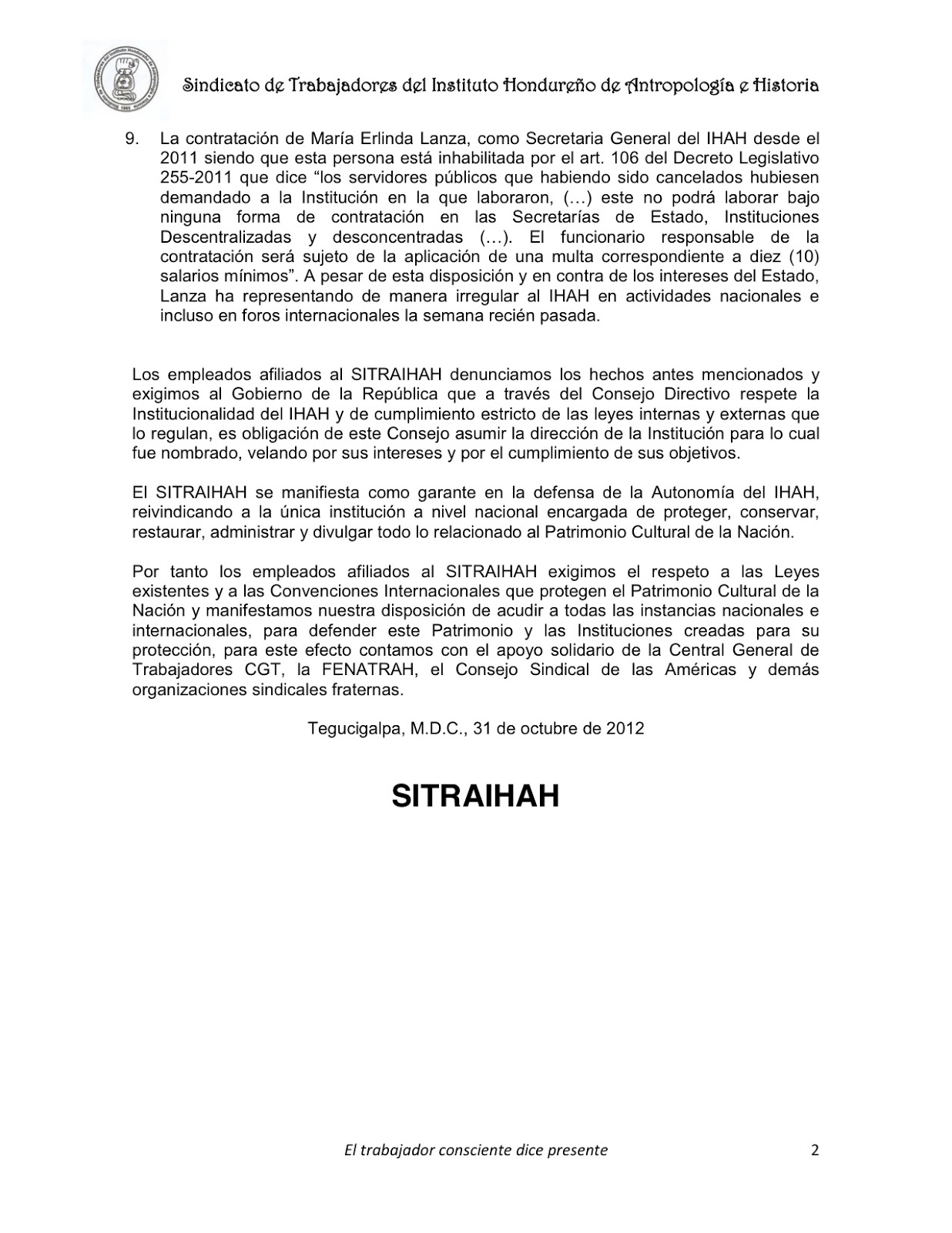
By law, the union notes, the advisory Council (Consejo Directivo) of the Institute is supposed to meet with at least 4 of its mandated members at least once a month. A circular from the IHAH union (available here as JPG images) states that
Beginning in the period of 2010 through 2012 the absence of sessions owing to the failure to convene them by the secretary of the Consejo Directivo, who is the Gerente of IHAH, has provoked profound damage to the Institution such as the signing of agreements that violate articles 2, 5, and 6 of the Ley Orgánica del Instituto, the total failure of the management, administrative negligence and abuse of authority on the part of the present Gerente, Ing. Virgilio Paredes Trapero.
Paredes was, as is described in many posts available online, appointed during the period of control by the de facto regime that took power in the coup of June 2009. The circumstances of his appointment have been questioned; he does not have the kind of degree called for in legislation governing the IHAH. While his patron, the more notorious Myrna Castro, who took over the power of the Minister of Culture during the de facto regime, moved on when Porfirio Lobo Sosa was inaugurated, Paredes, installed by Castro, has stayed in power.

We have written previously about the concerns raised by the union about Paredes' administrative actions. The new document emphasizes the same points.

The summary conclusion: Paredes is not interested in the survival of IHAH, and in fact wants to take it apart, to see it fail. While the present document is somewhat technical in its complaints, what the union has previously emphasized is a pattern of actions that either directly violate, or at least appear to violate, the law, and undermine the mission of the institute, which is to manage cultural heritage and increase public knowledge of it-- not, as Paredes has sometimes seemed to think, to increase tourism income in the country any way he can.

One new addition to the story in the present statement is the news that, following their previous complaints, a special commission was actually appointed in June of this year, including three members of the Consejo Directivo: UNAH representative, historian and professor Olga Joya, herself a former director of IHAH; and the representatives of COHEP, Jubal Valerio, and of SOPTRAVI Ángel Mariano Vásquez. The statement by the union says their report was not presented to the full Consejo, despite what they describe as numerous requests from the commission members themselves and the union.

The document describes an extraordinary pattern by Paredes of failing or even refusing to be part of meetings ordered by the Minister of Culture, to whom he in theory reports, intended to address the complaints raised. Other information we have received has described Paredes having a network of powerful patrons that give him a degree of impunity.

What will happen next? The union is obviously hoping that the government will act to rid itself of a troublesome bureaucrat who has brought unrest to governance, encouraged disruptive interventions by local politicians in national policy, and has, to say the least, not brought intellectual respectability to the Institute.

Which will win-- power and impunity, or prestige and embarrassment?

Monday, August 6, 2012

Cultural Policy in Honduras

A while back, I was invited to speak in Honduras on the topic of "the challenges and advances in the investigation of Ciudad Blanca", as part of the celebration of the sixtieth anniversary of the Honduran Institute of Anthropology and History (in Spanish the Instituto Hondureño de Antropología e Historia, or IHAH).

My already existing summer research plans precluded my accepting the invitation. I toyed with writing the remarks I would have made in the requested "pequeña ponencia" (brief talk) as a blog post here. But there were, frankly, more important things to do.

Now, as Adrienne Pine notes at Quotha, Virgilio Paredes, in charge of IHAH, has written a letter to El Heraldo, thanking them for their contribution to his project of publicizing "Ciudad Blanca", reproduced by that paper in a self-congratulatory ad about their coverage of the supposed discovery.

And that inspires me to follow through on the invitation I received, albeit a couple of weeks later than proposed, in this virtual forum.

What does the present head of IHAH mean when he writes about "los vestigios arqueologicos de la zona de la Mosquitia hondureña, de una civilizacion que puede haber sido la denominada Ciudad Blanca" [the archaeological vestiges in the Honduran Mosquitia, of a civilization that could have been that called Ciudad Blanca"]?

For an archaeologist, that sentence is painful to read. We are long past the time when we spoke in terms of "civilizations"; for us, the question of the archaeology of the Mosquitia is that of cultures represented, histories to be told, and social relations to be understood. Civilizations, unfortunately, can still be "discovered" and "explored"; social relations, histories, and cultural traditions need to be investigated and understood.

The LiDAR imagery produced undoubtedly shows evidence of past inhabitation of the Mosquitia. That is neither surprising nor particularly news. All of Honduras produces evidence of human occupation prior to the arrival of Spanish colonizers in the sixteenth century. The relatively low population of the Mosquitia today is an outcome of colonization and its aftermath. Knowing the reality of past habitation in the region requires us to ask what historical, political, and economic processes have disadvantaged the population in recent centuries.

Like much of the pre-hispanic past of Honduras, knowledge of the original distribution of towns and villages in the Mosquitia has been slow in developing, primarily due to over-valuation, both in Honduras and outside it, of the Classic Maya "civilization". This over-valuation of a Maya past became a shared obsession in North America and Honduras in the late nineteenth and early twentieth centuries. For North Americans, the Maya offered a civilization as "advanced" as the ancient Greeks-- a way to establish an advanced past in the Americas independent of that of the Classical world. For Central American elites, the Maya could provide antecedents for new nations, antecedents that were cultivated, desirable, and above all, up to the standards of global cultural centers.

The shared obsession with a purely Maya past led to a history of archaeological investigation that focused on the extreme western edge of the country; that normally asked-- and still too often asks-- the question "how were these other societies or cultures related to the Classic Maya?"; and that marginalizes the histories of the majority of the Honduran territory while generalizing the cultural tradition of the extreme margin of the country.

Against this background of "mayanization", attention to the archaeology of eastern Honduras should be welcome. But instead of building knowledge, the recent dramatic publicity about a supposed "discovery" of "Ciudad Blanca" takes refuge in tales of mystery with no basis in historical fact. As we have previously discussed, the legend of Ciudad Blanca is a modern fabrication, extending to false claims about the content of sixteenth-century Spanish documents.

Actual archaeological work conducted in the Mosquitia was ignored in the original publicity and continues to be ignored by the head of the IHAH. That research is of interest itself, because what it showed was an unexpected number of large sites occupied at the same time as Copan, and in some cases later. Some of these sites included architectural features recognizable as ballcourts, the kind of spaces where people from as far north as Arizona through Mexico and Guatemala played games using rubber balls. Not just significant as a sign of cultural identification with the zone to the north, but also socially significant as evidence of a practice through which different, independent towns participated in inter-site political, religious, and social relations, ballcourts had, until the early 1990s, been thought to be limited to the western edge of Honduras.

Yet the archaeology of the Mosquitia also showed abundant evidence of relations further south, to the societies of Costa Rica, Nicaragua, and Panama. In some ways this was unsurprising: people in Nicaragua and Costa Rica valued the beautiful marble vases carved in the Ulua valley, and emulated the painted pottery of the Ulua tradition in their own locally made ceramic vases. But the modern history of archaeological research in Honduras had, since at least the 1930s, emphasized a break between western Honduras, connected with the Maya and other societies west and north, and the peoples of southern Central America.

What the archaeology undertaken in the 1990s (with little institutional backing or financial support) in the Mosquitia-- and in the department of Yoro, and more recently, in Olancho and the Jamastran valley-- demonstrated was that the old model of two blocs separated by a "frontier" was untenable. Instead, Honduran sites further east than the so-called "frontier" expanded our understanding of the geographical scope of travel, exchange, and knowledge, showing that before colonization by the Spanish, all of Mexico and Central America constituted an active chain of interconnected societies, ultimately linked north to the pueblos of the US Southwest and south into the mountains of Colombia, and perhaps beyond.

These were cosmopolitan peoples. Renewed investigation of the Mosquitia has the promise to remind us of this, and enforce real attention to the mechanisms through which this chain of societies were connected over their long histories.

Unfortunately, there is little likelihood that the present campaign by the IHAH will yield reliable knowledge, even if an expedition is mounted to the sites located through LiDAR imaging. Knowledge is not the same thing as discovery. Knowledge comes from building on what went before; the relentless promotion of the new data as unprecedented stands in the way of trying to honestly compare these sites to those known from the region, and across Honduras. The desire to link these real places to a modern myth, with its highly marketable narrative of lost cities of gold, has already distorted the process of archaeological research. How, in this time of high politicization of archaeology in Honduras, could any government-sponsored expedition dispute the claim that this is the discovery of a lost "civilization", Ciudad Blanca, and instead acknowledge that these sites are like those already known from previous research in the Mosquitia?

The greatest promise of following up on the new LiDAR imagery might be the potential to renew archaeological research outside the Copan zone. The greatest challenge presented is a fact cited by the manager of the Institute in his letter to El Heraldo. Paredes writes:
The government of the Republic presided over by Porfirio Lobo Sosa is working to fortify the economic development of the country through the Cultural Patrimony as a resource that should be used in a responsible and sustainable form, therefore, we do not doubt that the enhancement of such an important site will come to drive the economic development of the country without taking away from the natural and cultural riches that are encountered in the zone of the Mosquitia.

What is wrong here?

The mission of the Honduran Institute of Anthropology and History is not to exploit sites of cultural and historical importance for economic development. That would be a reasonable statement of the mission of the Institute of Tourism. This passage shows a fundamental lack of understanding of the mission of IHAH. And that lack of understanding of the mission of the Institute, on the part of the person appointed to direct it, is the greatest challenge for any archaeology in Honduras today.

The law governing the Institute of Anthropology and History, established in 1968 and revised in 2008, says that its purpose is
the defense, exploration, conservation, restauration, repair, recovery and growth, and scientific investigation of the archaeological, anthropological, historic and artistic treasures of the nation, as well as places of tradition and natural beauty.

Nothing there, or in the articles that follow, about economic development. Indeed, article 26 explicitly enjoins against approving exploration for any reason other than "scientific investigation":
Projects that could discover archaeological monuments, like the exploration of those already discovered, shall have the exclusive goal of scientific investigation, therefore, the Institute cannot concede permission to persons who are pursuing other ends.

Under the law, sites are supposed to be of interest for one of two reasons: due to their relation to the "social and political history" of the country; and for their "exceptional artistic or architectural value that they characterize as an exemplar of national culture". Again, no mention of economic exploitation.

Also relevant to this discussion of the challenges to an "archaeology of Ciudad Blanca" is the Law for the protection of the Cultural Patrimony. Passed in 1997, it sets out at the beginning the value of the cultural patrimony:
Cultural properties constitute one of the foundations of the culture of the people and acquire their true value when their origin, history, and context are known with precision and are disseminated for the knowledge of the population.

The cultural patrimony law repeatedly cites the role of the Institute of Anthropology and History in the protection of the cultural patrimony-- not in its exploitation for economic ends.

In theory, there is no contradiction between sponsoring research-- the job of the Institute of Anthropology-- and contributing informed understanding to the development of historic and archaeological sites for visitation that is at one and the same time of economic benefit and a means to educate the public about the Honduran past.

In theory.

In practice, when economic development trumps scientific investigation and dissemination of historical knowledge, as clearly is the case in the unfounded promotion of sites in the Mosquitia as the mythical Ciudad Blanca, the interests of the Honduran people in real knowledge about the past are submerged under the desperate pursuit of money.

Monday, May 28, 2012

El Mito de Ciudad Blanca

(Para nuestros lectores en Honduras...Traducido del Inglés)
(This is for our readers in Honduras....translated from our English post)

Con titulares como Honduras: Afirman haber encontrado Ciudad Blanda, y Con rastreo satelital comprueban la existencia de Ciudad Blanca, la prensa Hondureña comenzó a tocar la trompeta, una vez mas, el descubrimiento de la Ciudad Blanca, la Ciudad Blanca mítica supuestamente situado en algún lugar en el oriente de Honduras.

La última "revelación" de que Ciudad Blanca había sido localizado fue anunciado por Porfirio Lobo Sosa en una reunión de gabinete el martes pasado.

Un artículo de uno de los diarios describe que el supuesto lugar cubre 5 kilómetros cuadrados. Áfrico Madrid, el Ministro del Interior, dijo que el equipo alegando el descubrimiento podría haber encontrado el legendario (sus palabras) Ciudad Perdida o Ciudad Blanca en la región conocida como la Mosquitia, y que podría ser más grande que el sitio de Copán, en el oeste de Honduras.

Virgilio Paredes, quien dirige el Instituto Hondureño de Antropología e Historia, dijo:
"Sabemos que tenemos algo y que tenemos que ir a esta zona para saber lo que la cultura era lo que vivía allí".

Paredes también es citado diciendo:
Hemos encontrado lo que podría ser, según los arqueólogos e historiadores, lo que podría ser el mayor descubrimiento arqueológico en el mundo del siglo XXI, una ciudad perdida. No sabemos lo que es, no sabemos si se trata de una estructura (edificio), pero su estado afirmado por especialistas que conocen esta tecnología y la disposición de la tierra, que hay muchas estructuras artificiales.

"El mayor descubrimiento arqueológico del mundo en el siglo XXI"!

Ahora que ya ha escuchado la sensacional promoción, aquí están los hechos.

La fuente de tal emotividad es un comunicado de prensa por la UTL Scientific y el Gobierno de Honduras titulado The Government of Honduras and UTL Scientific, LLC Announce Completion of the Frist-Ever LIDAR Imaging Survey of La Mosquitia Region of Honduras.

Si usted lee el comunicado de prensa, usted encontrará que no tiene la pretensión de haber descubierto Ciudad Blanca.

LIDAR ("Light Detection and Ranging" en Inglés, "Detección Aérea de Luz y Medidas de Rango" en Español) rebota la luz de un láser desde un aeronave al paisaje y hace una imagen precisa tanto de la superficie del suelo y la vegetación en él. El procesamiento de las señales le permite quitar la imagen de la vegetación y obtener un modelo exacto de la topografía bajo ella.

Cuando esto se hizo con los nuevos datos de la Mosquitia hondureña, los analistas vieron algo que les parecía los restos arquitectónicos de antiguas ciudades, una serie de sitios arqueológicos.

El trabajo real del LIDAR fue hecho por el Centro Nacional para el Mapeo de láser aerotransportado (NCALM por sus siglas en Inglés), un laboratorio de instrumentación en la Universidad de Houston, financiado por la National Science Foundation de EE UU para ayudar a facilitar este tipo de estudios.

Por supuesto, el comunicado de prensa en realidad no viene de NCALM. Viene de UTL Científico, LLC.

UTL Scientific es una compañía de cine haciendo un documental. Se maneja la organización y la logística en Honduras para el reconocimiento de la superficie LIDAR. La gente de UTL, cuyas hojas de vida breves se incluyen en el comunicado de prensa, son cineastas, escritores y aventureros, pero no científicos.

El anuncio del martes no es el primer supuesto "descubrimiento" de la Ciudad Blanca por aventureros que utilizan la "ciencia". 

En 2006, James Ewing, junto con Francis Yakam-Siman y Nezry Edmond, afirmaron haber descubierto Ciudad Blanca utilizando imágenes de la Mosquitia de la técnica Radar de Apertura Sintética (SAR por sus siglas en Inglés).

El resultado final de la utilización de SAR es similar a LIDAR, un modelo de la topografía de una región. El estudio de la SAR en 2006 también pareció de mostrar los restos arqueológicos bajo el dosel de la selva de la Mosquitia. Las características recientemente descubiertas podrían incluso ser los mismos fotografiados en ese entonces. No lo sabremos hasta que suelten las coordenadas geográficas de la región, este último proyecto de crear una imagen. Todo lo que sabemos es que el proyecto se centró en un área marcada en un mapa realizado por el fabricante del primer mapa de Honduras, Enrique Aguilar Paz, como la ubicación de la legendaria Ciudad Blanca.

Que los datos LIDAR muestran posibles sitios arqueológicos en la Mosquitia no debe ser una sorpresa para nadie. Los trabajos pioneros arqueológicos de Chris Begley en la Mosquitia mostraron que habían numerosos sitios a lo largo de los ríos, y que algunos de ellos eran bastante grandes.

Begley explica los rasgos del mito de Ciudad Blanca en su página web.

La historia de Ciudad Blanca se basa en tres puntos de referencia, dos de ellas supuestos menciones históricas, la tercera con raices en las tradiciones Pech y Tawahka.

Los dos documentos históricos fueron escritos por Hernán Cortés (en 1525) y Cristóbal de Pedraza (en 1544). Si bien presentadas como descripciones coloniales de Ciudad Blanca, pero en realidad no se refieren a una ciudad blanca, o una ciudad perdida.

Cortés escribió su famosa quinta carta a Carlos I de España después de regresar de su igualmente famoso viaje a Honduras. En su viaje a Honduras permaneció cerca de la costa, sin llegar más allá del este de la ciudad de Trujillo.

Al hacer una discusión del valor de control de Honduras para el imperio español, escribió:
He recibido noticias de las provincias muy grandes y ricos con los señores ricos, ricos asistieron, especialmente la que llaman Hueytapalan o en otro idioma, Xucutaco que yo ... han descubierto, por fin, ocho o diez días de marcha de Trujillo, que es decir, unos 50 o 60 leguas.
La referencia es a las provincias, no a las ciudades. No hay mención de una ciudad blanca o perdida. Ya que Cortés no visitó la Mosquitia, lo unico que esta carta podría aportar son rumores acerca de las zonas más al este.

La fuente de la riqueza de estas provincias y sus señores suele inferirse de la segunda fuente histórica citada, una cuenta de la colonia de Honduras por su nuevo obispo Cristóbal de Pedraza, en 1544. Allí, él escribió observando desde la cima de una montaña en algún lugar al este de Olancho:
Vimos una muy parte de tierra de la otra parte della al este de muy grandes poblaciones y la tierra que nos parecia con muchos rios.
Pedraza mandó llamar a algunos indios de la region para preguntarles sobre las tierras que habia visto:
y preguntandoles por nuestros naguatatos que quiere decir interprete que tierra era aquella respondieron que taguisgualpa, que quiere decir en su lengua donde se funde el oro | por respecto que en el pueblo mas principal della esta una casa de fundición, y vienen de muchas partes de la tierra a fundir oro y de aquellas sierras que dicen que son cerca de Veragua.
La Provincia de Taguzgalpa corresponde a la parte oriental de Honduras. Fue ocupada por los Tawahkas, Pech, Misquitos y Sumos.

"Veragua" se refería a la costa de Centroamérica, desde Nicaragua hasta el río Belén, en Panamá. Históricamente, este era un lugar donde trabaja la orfebrería precolombina.

En contraste, los sitios arqueológicos en Honduras, aunque han provisto muchos ejemplos de objetos de aleación de cobre, no eran por lo general fuentes de oro. Una figura de oro completa que se encontró en el valle del río Ulúa era claramente un objeto importado, hecho en la zona de Costa Rica-Panamá. Fragmentos de otra figura semejante fueron enterrados debajo de la Estela H de Copán. Sin embargo, la zona productora de oro fue a un largo camino desde Honduras. Lo que estos descubrimientos prehispánicos atestiguan es la existencia de una red de intercambio y de viajar desde Honduras a Panamá - la misma red que transmitió los informes sobre lejanas provincias ricas en trabajos de oro a Cortés y Pedraza.

Mientras que Pedraza recibió una descripción de una ciudad dedicada a la producción de objetos de oro no obtuvo una mención de una ciudad blanca o perdida.

Chris Begley ha escrito trabajos académicos sobre la leyenda Ciudad Blanca. En su articulo "Leyendo y Escribiendo la Leyenda de la Ciudad Blanca: Alegorías del pasado y futuro", publicado en 2007 en Southwest Philosophy Review, Begley y Ellen Cox apuntan que Begley habia recogido más de 5 menciones diferentes de las ruinas que los informantes (personas no indígenas) dijieron eran la Ciudad Blanca.

Este artículo también arroja luz sobre la tercera fuente citada por los aficionados que afirman haber encontrado o que diecen buscar la Ciudad Blanca. Begley cuenta que los pueblos Pech y Tawahka de Honduras tienen mitos sobre Wahai Patatahua ("lugar de los antepasados") y Kao Kamasa ("la casa blanca") en la cabecera de la confluencia de dos ríos, al lado de un paso a través de las montañas. En la mitología Pech, esta ubicación es el lugar donde los dioses se retiraron después de la llegada de los Españoles. Begley dice que el Pech identificaron este lugar con la parte remota de sus tierras en la Mosquitia.

Ciudad Blanca, en otras palabras, no es una ruina específica con una herencia que va desde las historias de la época colonial española hasta el presente. No hay un solo lugar que sea la Ciudad Blanca. Por el contrario, como Chris Begley ha demostrado a través de su intensa investigación, hay una serie de sitios arqueológicos por debajo de la densa selva en partes no desarrolladas de la Mosquitia. Eso no es sorprendente ni es noticia.

La SAR y LIDAR son herramientas maravillosas y costosos para la búsqueda de yacimientos arqueológicos. Tampoco están dentro del presupuesto que normalmente tienen disponibles los arqueólogos.

El estudio LIDAR que promociona el gobierno hondureño, pero observamos no por algun arqueólogo Hondureño o internacional, fue valorada en $ 1,5 millones.

La historia de "Ciudad Blanca" es una gran leyenda. Por lo que no es de extrañar que una empresa de filmación apoyaría la historia del descubrimiento y la (posible) tesoro que representa.

Sin embargo, el Instituto Hondureño de Antropología e Historia debe proporcionar un conocimiento confiable sobre el pasado al pueblo hondureño, y las audiencias internacionales.

Sunday, May 20, 2012

Mythical Ciudad Blanca

With headlines like Honduras asserts it has found the White City and With a satellite search they proved the existence of the White City, the Honduran press began trumpeting, yet again, the discovery of Ciudad Blanca, the mythical White City supposedly located somewhere in eastern Honduras.

The latest "revelation" that Ciudad Blanca had been located was announced by Porfirio Lobo Sosa in a cabinet meeting on Tuesday.

One newspaper article describes the supposed site as being 5 square kilometers. Áfrico Madrid, the Interior Minister, said that the team claiming the discovery could have encountered the legendary (his words) Lost City or White City in the region known as the Mosquitia, and that it could be bigger than the site of Copan, in western Honduras.

Virgilio Paredes, who manages the Honduran Institute of Anthropology and History, said:
"We know that we have something and that we have to go into this zone to know what culture it was that lived there.

Paredes also is quoted as saying:
We have found what might be, according to archaeologists and historians, what might be the biggest archaeological discovery in the world of the twenty-first century, a lost city.  We don't know what it is, we don't know if it is a structure (building), but its been affirmed by specialists who know this technology and the lay of the land, that there are many man-made structures.

 "The biggest archaeological discovery of the world in the twenty-first century"!

Now that you've heard the hype, here's the facts.

The source of the excitement is a press release put out Tuesday by UTL Scientific and the Government of Honduras, titled The Government of Honduras and UTL Scientific, LLC Announce Completion of First-Ever LiDAR Imaging Survey of La Mosquitia Region of Honduras.

If you read the press release, you'll find it does not claim to have discovered Ciudad Blanca.

LIDAR (Light Detection and Ranging) bounces lasers off the landscape and makes an accurate image of both the ground surface and the vegetation on it. Processing of the signals allows you to virtually strip off the vegetation and get an accurate model of the topography underneath.

When this was done with the new data from the Honduran Mosquitia, the analysts saw something that looked to them like the architectural remains of old cities, a series of archaeological sites.

The actual LIDAR work was done by the National Center for Airborne Laser Mapping (NCALM) an instrumentation lab at the University of Houston, funded by the National Science Foundation to help facilitate studies of this kind.

Of course, the press release doesn't actually come from NCALM. It comes from UTL Scientific, LLC.

UTL Scientific is a film company making a documentary. It handled the organization and logistics in Honduras for the LIDAR survey. The UTL people, whose brief biographies are included in the press release, are filmmakers, authors, and adventurers, but not scientists.

Tuesday's announcement is not the first purported "discovery" of Ciudad Blanca by adventurers using "science".

In 2006, James Ewing, along with Francis Yakam-Siman and Edmond Nezry, claimed to have discovered Ciudad Blanca using Synthetic Apeture Radar (SAR) images of the Mosquitia.

The end result of using SAR is similar to LIDAR, a model of the topography of a region. The SAR study back in 2006 also appeared to show archaeological remains beneath the forest canopy in the Mosquitia. The newly discovered features might even be the same ones imaged back then. We won't know until they release the geographic coordinates of the region the latest project imaged. All we know is that the project targeted an area marked on a map made by the first Honduran map maker, Enrique Aguilar Paz, as the location of legendary Ciudad Blanca.

That the LIDAR data shows possible archaeological sites in the Mosquitia should come as a surprise to no one. Pioneering archaeological work by Chris Begley in the Mosquitia showed that there were numerous sites along the rivers, and that some of them were quite large.

Begley outlines the myth of Ciudad Blanca on his website.

The Ciudad Blanca story rests on three points of reference, two of them supposed historical mentions, the third based in Pech and Tawahka tradition.

The two historical documents were written by Hernan Cortés (in 1525) and Cristobal de Pedraza (in 1544). While offered as colonial descriptions of Ciudad Blanca, neither actually refers either to a white city, or to a lost city.

Cortés wrote his famous fifth letter to Charles I of Spain after returning from his equally famous trip to Honduras. While in Honduras he stayed close to the coast, reaching no further east than the city of Trujillo. Making an argument for the value of controlling Honduras to the Spanish empire, he wrote:
I have received news of very large and wealthy provinces with wealthy lords, richly attended, especially the one they call Hueytapalan or in another language, Xucutaco which I....have discovered at last is eight or ten days march from Trujillo, that is to say, some 50 or 60 leagues.

The reference is to provinces, not cities. There is no mention of a white or lost city. Since Cortes did not visit the Mosquitia, all this letter could provide would be rumors about areas further to the east.

The source of the wealth of these provinces and their lords is usually inferred from the second historical source cited, an account of the colony of Honduras by its new bishop, Cristobal de Pedraza, in 1544. There, he wrote of standing looking east from the top of a mountain somewhere east of Olancho, Honduras:
We saw a large piece of land, and in the other part of it, to the east, with large towns (or populations) and the land with many rivers.

He sent for some local Indians to ask about the lands that he saw:
and asking through our interpreters what land it was, they replied that it was Taguisgualpa which in their language means the place where they smelt gold because in their most important city there is a gold work where they come from many parts of the land to smelt gold, and from the surrounding mountains that they say are close to Veragua.

The Province of Taguzgalpa, as it became known, corresponded to eastern Honduras. It was occupied by the Tawahka, Pech, Miskito, and Sumo.

"Veragua" referred to the lower Central American coast, from Nicaragua through to the Rio Belen in Panama.  Historically, this was a location of Precolumbian goldworking.

In contrast, Honduran archaeological sites, although yielding many examples of copper alloy objects, were not generally sources of gold. One complete gold figure found in the Ulua River valley was clearly an imported object, made in the Costa Rica-Panama area. Fragments of another such figure were buried below Stela H at Copan. But the gold-producing area was a long way from Honduras. What these pre-hispanic discoveries attest to is a network of exchange and travel reaching from Honduras to Panama-- the same network that conveyed reports about distant wealthy provinces of gold workers to Cortes and Pedraza.

While Pedraza was given a description of a city focused on the production of gold objects (Cibola anyone?) he did not get a mention of a White or Lost City.

Chris Begley has actually written scholarly papers about the White City legend. In "Reading and Writing the White City Legend: Allegories Past and Future", published in 2007 in Southwest Philosophy Review, Begley and Ellen Cox note that Begley has been taken to more than 5 different sets of ruins that informants (non-indigenous people) said were the Ciudad Blanca.

This article also sheds light on what is usually the third source cited by enthusiasts claiming to have found or to be seeking Ciudad Blance. Begley recounts that the Pech and Tawahka people of Honduras have a myth about Wahai Patatahua ("place of the ancestors") and Kao Kamasa ("the white house") at the headwaters of the confluence of two rivers, by a pass through the mountains. In Pech mythology, this location is the place to which their gods retreated after the Spanish came. Begley says the Pech identified this location with the wild and remote part of their lands in the Mosquitia.

Ciudad Blanca, in other words, is not a specific ruin with a charter that runs from the colonial Spanish histories to the present. There is no single place that is Ciudad Blanca. Rather, as Chris Begley demonstrated through hard fieldwork, there are a series of archaeological sites underneath the heavy forest in undeveloped parts of the Mosquitia. That's neither surprising nor news.

SAR and LIDAR are wonderful and expensive tools for finding archaeological sites.  Neither is within the normal budget of archaeologists.

The LIDAR study being touted by the Honduran government, but not, we note, by any Honduran or international archaeologists, was valued at $1.5 million.

The "Ciudad Blanca" story is a great legend. It is hardly surprising that a media company would support the storyline of discovery and (potential) treasure that it represents.

But the Honduran Institute of Anthropology and History should be providing reliable knowledge about the past to the Honduran people, and international audiences.

Thursday, March 8, 2012

Copan Seized

Employees of the Honduran Institute of Anthropology and History have taken over Copan Archaeological Park, protesting the agreement signed by Africo Madrid and Helmy Giacoman, that is apparently being implemented by the Institute.

The employees reject the proposed changes to the law on cultural patrimony, changes that would give municipalities control over archaeological materials found within their boundaries, and a position on the Consejo Directivo (essentially, the Advisory Board) of the Institute.

In addition, the employees oppose the proposed bill now being considered in Congress that would give 50% of the proceeds from admissions to the park to the town of Copan Ruinas.

They have called for the immediate removal of the director of the Institute, Virgilio Paredes and other Institute employees that have supported the agreement.

The employees agreed to reopen the park at noon today.

Saturday, March 3, 2012

Radio America: Virgilio Paredes Reassures Copan

More than a week before the signing of an accord that gave the municipality of Copan Ruinas unprecedented control over what by law in Honduras is a shared cultural patrimony, Radio América interviewed Virgilio Paredes, the otherwise silent bureaucrat who has been managing the Honduran Institute of Anthropology and History, about what was then a crisis under development. The transcript of that interview provides a window into just how the Institute let the situation escalate, ending up with a cabinet minister imposing an unprecedented agreement that guts the mission of the Institute itself.

Here's our translation of the most relevant parts of the interview, with commentary added:
Emmanuel Tercero, journalist in the booth: Carlos Rivera tells us that there are problems between the alcalde (mayor) who does not want archaeological pieces to be taken with the permission of the Instituto Hondureño de Antropología e Historia, to take important pieces for an exhibition in a museum in the US. Carlos Rivera from the west of the country...

Good afternoon. This morning we spoke as well with Virgilio Paredes of the Instituto Hondureño de Antropología e Historia who told us that the Maya-Chorti community is in agreement that original archaeological pieces will be transported to Pennsylvania, US, for an exhibition.

[Comment: it seems that Paredes is here arguing that the Maya Chorti do have a right to have their opinions heard, and that they had agreed to the exhibition.]
... but the Alcalde of Copan Ruinas, Helmy Giacoman, who is also preoccupied, is in communication, a brief summary of what is happening, go ahead, Alcalde...

Statement of Helmy Giacoman, Alcalde of Copan Ruinas: Good afternoon, the truth is that the town of Copan is extremely preoccupied by what has been being given these days, the truth, with the exhibition of these pieces at an international level and the truth is that we are very preoccupied... the people also found out about this and the truth is that the local media well, there has been circulating a lot about this business, because there are very disastrous antecedents for the patrimony of Copan Ruinas, when pieces have been taken outside the country and were lost in foreign territory, so it is explicable, completely explicable, to think that the town is very preoccupied, because these pieces have an incalculable value since the value that they have for what is the patrimony of Honduras, and the truth is that we are really preoccupied.

[Comment: What Giacoman is referring to is an incident in 1999 when a jade object from Copan, part of a traveling exhibition that was originally in Venice, went missing in Mexico, where the second site for the installation, the Colegio de San Ildefonso, simply did not have appropriate security. This theft, and others at the site and elsewhere, have been cited since at least 2004 in arguments by the municipality of Copan Ruinas claiming a voice in management of the pieces excavated from the site, and in proceeds from visitation there.]
Well, thanks to the Alcalde of Copan Ruinas, Helmy Giacoman, for letting us glimpse this concern, now that they propose to transport archaeological pieces to Pennsylvania, US for an exhibition, but what will Virgilio Paredes of the Instituto Hondureño de Antropología e Historia say on this point.

Well, thanks Carlos, as it happens we have Virgilio Paredes, director of the Instituto Hondureño de Antropología e Historia, how do we take away this concern of the Alcalde and the people there in Copan Ruinas, about this idea or this intention that there is, is it a reality, for how many pieces, what guarantees it, the process, the respective guarantees, the inventories so that there will not be losses of the same, Virgilio Paredes, we are listening on Radio America...

Declarations of Virgilio Paredes: Good afternoon, we want to say to you that the Instituto Hondureño de Antropología e Historia has been working on this exhibition for approximately a year, to undertake an arduous process of analysis, to see which pieces can be transported, under what conditions and in the framework of the Ley de Patrimonio Cultural de la Nacion, to establish that the Instituto Hondureño de Antropología e Historia is who will have these pieces in custody, and that in the care and restoration of these pieces, and in the framework of the same Law they also will establish the processes to loan archaeological pieces.

As you will know the Archaeological Park of Copan is patrimony of humanity, World Heritage, it isn't just national heritage, so it is in this framework in which we have Agreements... we try to promote tourism, to promote the tourist portion of all that is Maya archaeology...

So what the Law establishes has been followed, and what the Law sets up are the following processes: the Institute comes, verifies the pieces, speaks in this case with the University of Pennsylvania, with which there has been communication for approximately a year, and the pieces are identified that are going to be loaned to promote Honduras and Copan Ruinas outside the country, unfortunately we have been hearing a lot of bad news about what happened in the prison, the deaths and so many bad things about Honduras that are being promoted, this is one piece of good news for Honduras.

[Comment: notice the confusion between what properly is the role of the Institute of Anthropology-- the protection, interpretation, and sharing of information about Honduras cultural patrimony-- and what should be the work of other government agencies, like the Institute of Tourism, or even private enterprise. Most of the dialogues about Copan seem to end up really being about income that can be generated from Copan. And of course, the role of the Institute should be more than promoting Maya archaeology, since that is only one part of Honduras cultural heritage. It is also shocking to see the contrast drawn so starkly: the massive deaths caused by the prison fire in Comayagua are unfortunately "being promoted" and in contrast, the proposed US exhibition is "one piece of good news" for Honduras.]

After asking who makes up the Consejo Directivo for the Institute, the reporter asks if the proposal was discussed and "socialized", e.g., debated with the relevant public stakeholders. Paredes responds:
It has been discussed, it is approved, so that everything is in order, we came and it was approved in conformity with the Law, this passes to the President of the Republic, the President and his Attorneys determine the processes, if everything is in [agreement with the] Law, of all the enumerated pieces photos and everything.

Emmanuel Tercero: How many pieces are we talking about? Paredes: 74 pieces.
Tercero: What benefits is this going to bring? Paredes: There are various benefits, first the University of Pennsylvania, which is the warrantor that we are going to have, is going to promote Copan Ruinas, there will be publicity internationally, it is a museum that will be open for all the US, in the framework of 2012 it will come to assist in training, in institutional strengthening, in assistance for conservators, in all the team that is necessary where we do not have resources.

Tercero: Is there a guarantee that [the pieces] will return intact, then? Paredes: The guarantee is the Law itself, in our vaults there are pieces, these 74 are already classified, they are photographed, and we have the list already, they are already authorized by the President, with their photos, that is what we are going to do ourselves, and that I wanted already today to deliver formally and officially to the Alcalde, it is a shame that I could not see him, since the official note with the photos and the list, with those photos and the list the Alcalde was asked for a representative.

Then within three weeks that the insurance is approved, the boxes and everything, then I will need a representative of Civil Society and a representative of the Municipality, so that they can come and see and verify each one of the pieces when they are going to be packed, so that those that have the documentation can verify what it is that is leaving the country, there will be representatives of the DEI and they will close everything and it will go to the US, in February of the next year when the pieces arrive, I will need both the Institute with the Civil Society and the Alcalde's office to sit down, we will open each box and verify that all that went is exactly what came back, that it isn't replicas that come, and it will guarantee that all that left the country is exactly what it is.

Tercero: Well, here we should ask something don Virgilio, [the mayor?] said "well, we are also bringing tourists, so if they take away all the pieces or even just a part, well then the tourists that come here aren't going to see anything?" Paredes: Look, we have more than 5000 pieces, so 74 is nothing in comparison, the problem that we have is a grave problem notice that we do not have a museum with the international standards of climate control, of environment, of lighting and of security to be able.. the good news that we have for the Honduran people is that via the Government of Japan there is now being given us approval to build a museum of international level in Copan Ruinas.

Tercero concludes: Well, Alcalde Municipal Helmy Giacoman of Copan Ruinas and Virgilio Paredes, Director of the Instituto Hondureño de Antropología e Historia, about these pieces that are going to be removed and that this is in keeping with agreements and in accordance with the Law and that it is going to be approved by the Executive branch, and that [Paredes] is going to meet there with the Alcalde to clear up doubts.

[Comment: about ten days later, an accord signed by the Alcalde and, on behalf of the government, the minister of the interior, but not by Virgilio Paredes, conceded to the people of Copan Ruinas not only the degree of participation in packing and unpacking proposed here; but much more besides. Not involved in these negotiations: the Minister of Culture, who should have been the representative of the Executive branch in this case.]

Friday, March 2, 2012

Copan is falling and so is the Cultural Patrimony...

We previously discussed the signing of a document that entirely violates the Honduran law in regard to the national cultural patrimony, and translated that document.

In the first post, we noted that Virgilio Paredes (appointed to head the Honduran Institute of Anthropology and History by Myrna Castro during the waning days of the de facto regime of Roberto Micheletti) was curiously absent from accounts of the signing of the accord ceding to the Municipal government of the town of Copan Ruinas many aspects of the management of that World Heritage site. While referenced by title in the accord, he is not named either.

Some correspondents raised the idea that the Institute and its officers were not actually committed by this agreement; that it was executed as a kind of sop to the people of the town, angered by proposed loans of objects for exhibition in the US.

But we also have received another document, and this one demonstrates that, far from protesting the illegal accord that was signed by Porfirio Lobo Sosa's representation, Africo Madrid, the Institute's legal counsel already, on February 27, has begun to put it into action.

The letter-- on letterhead of the Institute of Anthropology and History-- is directed to the mayor of Copan Ruinas, Helmy Rene Giacoman. It is signed by Attorney Erlinda Lanza, General Secretary of the Institute, and is copied to the office of the director of the Institute.

Here's what it says:
Esteemed Mr. Mayor:

I inform you that I met with Maria Miranda, Jose Ramon Murillo and Omar Antonio Rios, finalizing the details of the Supervisory Commission for the transport of pieces to the University of Pennsylvania.

I was informed that the Commission proposed by the Municipal Mayoralty would be composed in the following manner:

1. Maria Miranda, Education District
2. Jose Ramon Murillo of the 2012 Committee
3. Omar Antonio Rios Head of the Municipal Tourism Unit
4. Ingmar Diaz 2012 Committee
5. Brenda Rivera Representative of the indigenous communities
6. Martha Emma Melendez member of the Municipal Council of Transparency who also will be the custodian designated for the transport of the pieces to the US

The said committee will have to be present for 5 or 6 days, eight hours daily in the building that the CRIA occupies for the packing of the pieces and they will be attended and instructed by the Institute technician Norman Martinez, Registrar of Cultural Properties.

We spoke about the points that are described in the Copan Ruinas 2012 agreement of the 26th of February and it was determined that on point 2, while the Ley Orgánica del IHAH is not reformed, the participation of the AMHON in the Consejo Directivo of the Institute, if the Consejo itself considers it, will be solely as an observer.

With respect to point 3, it was resolved that the same commission previously named will review the inventory and will be on the record that the Maya pieces are in each one of the sites.

With respect to point 4 the elaboration of a protocol on the part of the Institute was proposed that would regulate the presence of members of the Municipal Corporation so that they shall be present in the excavations, discovery, and exhibition so that they can attest to transparency while the lay and regulations of protection are reformed.

With respect to point 5, attached you will encounter Circular No. 412-G-2011 dated 13 December of 2012, directed to the commission of Finances of the National Congress through which IHAH presented what its position was with respect to the decree through which it is proposed that a percentage of the income of the Copan Archaeological Park should pass to the Municipal Mayoralty. [This document was not attached to the copy sent to us.]

Both point 5, as well as point 6 (sales of tickets outside the country) and 8 (reform of the Ley para la Proteccion del Patrimonio Cultural de la Nacion) will depend on the Sovereign National Congress of the Republic with actions carried out by this Municipality.

Point 7 will be completed with the nomination of the commission that at the beginning of this report was laid out, and in addition the University of Pennsylvania will send to you an invitation so that you will participate in the inauguration of the event as well as the costs of one person designated by this municipality so that he should be one of the custodians of the pieces, who will participate both in the transmission as well as the return of the same.

And finally point 9 are matters specific to the Municipal Mayoralty.

In the hope that this will be the beginning of a permanent conversation,

Attentively,

Attorney Erlinda Lanza.

Wednesday, February 29, 2012

The Death of the Honduran Institute of Anthropology and History

Virgilio Paredes, Director of the Instituto Hondureño de Antropología e Historia (IHAH), and Áfrico Madrid, Interior Minister, appear to have sown the seeds that will ultimately reduce the IHAH to inconsequence and put the national patrimony of Honduras at risk.

Under Honduran law, all archaeological and historical sites and objects are the property of the people of Honduras, with the Instituto Hondureño de Antropología e Historia the guardian of this patrimony. IHAH is charged with conducting and regulating research on this national patrimony, with managing both the movable property and sites, and with disseminating knowledge of the patrimony to the people who are its ultimate owners.

A special office, the Fiscalia de Etnias, currently occupied by Jany del Cid, prosecutes violations of the law concerning national patrimony.

But the state government of Honduras has never footed the actual bill for the protection, management, or interpretation and public dissemination of the national patrimony. In 2012, the resources in the national government budget for IHAH (page A45 of the linked PDF of La Gaceta) looks like this:

42, 471,458

Income from Operations (admissions)

454,000

Rent

14,000,000

Transfers from the Central Government

8,151,484

Transfers of Capital from the Central Government

Total:

65,077,542


That's a total budget of $3.4 million dollars. $1.1 million is allocated by Congress.

But the larger portion, $2.2 million, is in income from visits to the national archaeological and historic parks and museums that IHAH maintains.

Less than a third of the budget is provided by the central government, and about two thirds of its budget is provided by income from visits to the parks and museums.

Where does the Institute spend its money? Here's the budget projections for 2012 (all amounts in lempiras):


36,893,777

Personnel

13,542,614

Services (phone, lights, water, etc.)

5,601,328

Materials

105,000

Transfers

663,339

Equipment

50,000

Books, Magazines, and Gifts

70,000

Intangible Assets

8,151,484

Construction and Improvements


The central government's budget contribution does not even cover the payroll of IHAH for a year.

It is only through the income from admission to archaeological and historical parks and museums that it can perform all of its services, which include:

  • maintaining the National Historical Archives
  • maintaining archaeological parks open to the public
  • educating the public about national patrimony and its protection
  • fostering local and national histories
  • protecting archaeological sites from looting and destruction
  • research when construction threatens an archaeological site
  • enter into international agreements to protect the national patrimony

Now, in an open meeting in the town of Copán Ruinas, Helmy Giocoman, Mayor of Copan Ruinas, and Áfrico Madrid, Minister of the Interior, decided that the law governing IHAH would be changed to give municipalities a say in whether archaeological pieces can be loaned to foreign museums or not.

They also agreed to fire Salvador Varela, the local representative of IHAH, for failure to adequately communicate with the local authorities.

The Instituto Hondureño de Antropología e Historia reportedly participated in this dismantling of its mission.

And it agreed that a percentage of the income from the park will be transferred to the local government. The agreement left the amount to be negotiated later. Copan Mayor Giocoman hopes it will be 50 percent of the income. There is nothing to suggest he will not get his way, as he has already in these unprecedented steps effectively appropriated control of a national patrimony for the economic benefit of a particular municipality.

The agreement was signed by Madrid as representative of the government, Giocoman, representing the town, and Rosa Maria Lopez, an IHAH lawyer.

Virgilio Paredes, the director of IHAH, was not present.

Wednesday, April 14, 2010

On April 8 Vos el Soberano posted a document dated March 18 issued by the union of the Ministry of Culture, SITRAECAD, demanding the immediate firing of Virgilio Paredes.

Who is Paredes? At present, he occupies the office of director of the Instituto Hondureño de Antropología e Historia (IHAH). During the de facto regime of Roberto Micheletti, he served Myrna Castro as administrator of the Ministry of Culture.

The union of workers in the Ministry of Culture accuse Paredes of continuing involvement in appointments to positions there, which they say went to relatives of Paredes. They specifically accuse Paredes and a colleague of manipulating the new Minister of Culture, Bernard Martinez, not letting him develop and exploiting the power that he is supposed to wield.

They also suggest that Paredes should be considered responsible for some of the financial irregularities that Minister of Culture Martinez publicized when he took over after the inauguration of Porfirio Lobo Sosa. They suggest the Tribunal Superior de Cuentas is ignoring these irregularities because Mirna Castro moved there as a high official after the end of the Micheletti regime.

The post notes that Castro named Virgilio Paredes as director of IHAH on December 14, 2009, filling the position left open when Castro moved against internationally respected historian Darío Euraque. As Vos el Soberano notes, Paredes lacks legally required qualifications: he does not have a degree in one of the academic fields specified (anthropology, archaeology, history) or a related discipline.

The inauguration of Lobo Sosa did not magically heal the damage done during the Micheletti regime. The ministry of culture, which went terribly off course under Myrna Castro, and the IHAH, where projects underway were canceled, are potentially important sites of creation of national identity, warped in the wake of the coup. The willingness of the unions to speak out shows that resistance extends broadly in Honduras today, and establishes a challenge for Minister Martinez.